Odometer Rollback Saudi Arabia How to Spot Mileage Fraud Before You Buy
If you’re shopping for a used car, odometer rollback Saudi Arabia is a real concern because mileage affects price, reliability, and resale. The good news is you don’t need to be a mechanic to catch most mileage tricks. You just need a calm checklist, a couple of consistency checks, and the discipline to walk away when the story doesn’t add up.
Why mileage scams happen and what rollback looks like in real life
In simple terms, rollback is when the displayed mileage is lower than the car’s real usage. Sometimes it’s intentional. Other times, the seller claims it happened by mistake after a cluster change or repair.
Either way, the risk is the same you could pay low mileage money for a car that’s been driven hard.
When low mileage is believable vs suspicious
Low mileage can be legit in KSA, especially for
- A second family car that barely gets used.
- A company car that was replaced early.
- A car owned by someone who travels a lot.
It becomes suspicious when
- The car looks and feels worn, but the mileage is too perfect.
- The seller can’t show even basic service proof.
- The story changes every time you ask a direct question.
The paper trail problem
Mileage is easiest to fake when there’s no trail no invoices, no workshop history, no consistent dates, no photos. That’s why your job as a buyer is to build a quick timeline before you pay anything.
Odometer rollback Saudi Arabia quick checks that catch most cases
These checks are fast and surprisingly effective. Do them in this order.
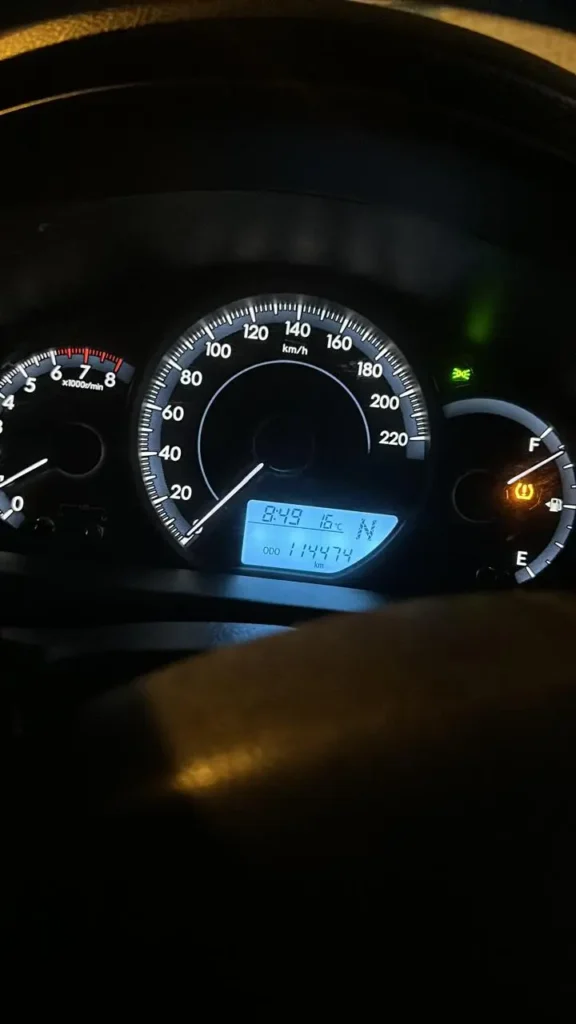
Compare wear vs. mileage your eyes don’t lie
Look at high touch wear points
- Steering wheel: smooth/shiny patches, peeling, uneven wear.
- Pedals: worn rubber, exposed metal, slippery feel.
- Driver seat: collapsed side bolsters, cracked leather, sagging cushion.
- Buttons and knobs: faded icons, loose controls.
A car showing very low mileage should generally look tight, not tired. One worn item is normal. Multiple worn areas? That’s your first warning.
Check maintenance notes and dates even basic proof helps
Ask for anything that shows a date + mileage
- Workshop invoice photos even WhatsApp screenshots.
- Service booklet stamps.
- Tire replacement receipts.
- Battery replacement invoice.
What you want to see is a smooth upward pattern over time. If you spot
- Mileage going down on a newer invoice, or
- Huge jumps that don’t fit the dates,
treat it as high risk.
Look for mileage jumps or resets pattern spotting
Red flags usually look like this
- It was 180,000 last year, but now it’s 92,000.
- The dashboard was changed, but there’s no paperwork.
- The car sat unused for years possible, but should be supported by proof.
If the seller mentions a cluster change, ask for
- Who did it workshop name
- When it was done,
- Any invoice or message thread.
No proof doesn’t automatically mean scam but it does mean you must verify harder.
Don’t ignore too clean stories
Be cautious of phrases like:
- No need to check, everything is perfect.
- I’m in a hurry, someone else is coming.
- I lost the papers, but trust me.
Pressure is often used to make you skip verification.
Use a vehicle history report as a cross check not the only proof
A report won’t replace a physical inspection, but it can help you cross-check what the seller claims.
Mojaz is an official service by Elm that provides used vehicle information in Saudi Arabia via the app/portal. The official Elm Mojaz PDF lists meter (odometer) readings among the features Mojaz can provide, which can be useful for consistency checks.
If you want the full step by step process, here’s my complete guide to running a Mojaz report before buying a used car.
You can also request the report directly from the official Mojaz portal/app here.
What a report can’t guarantee
A report reflects what’s available in connected records. It can help you spot inconsistencies, but it may not show every service visit or every event for every car.
So use it as a cross check, then confirm with:
- A professional inspection, and
- What you can verify from documents and condition.
A practical 10 minute routine before you pay a deposit
Use this routine every time. It’s fast and keeps emotions out of the decision.
Step 1: Ask these questions
- Do you have any service invoices or workshop history? Even photos are fine.
- Has the dashboard/cluster ever been repaired or replaced?
- When was the last major maintenance (tires, battery, brakes) and at what mileage?
- Can you send a clear photo of the odometer and the VIN/chassis number?
Step 2: Do a quick consistency scan
- Wear matches the mileage? ✅ / ❌
- Dates + mileage show a smooth timeline? ✅ / ❌
- Seller answers clearly, without pressure? ✅ / ❌
If you’re getting multiple ❌, don’t negotiate move on.
Step 3: Decide your next move
- Everything looks consistent: proceed to inspection + report cross check.
- One concern: verify with proof or workshop check.
- Several concerns: walk away. There are plenty of cars in the market.
Conclusion
Mileage fraud is avoidable in Saudi Arabia if you treat every deal like a quick investigation. Check wear, build a simple timeline from documents, use a report for consistency, and never pay a deposit under pressure.
Next step: If you’re serious about a specific car, run your cross check and then book a proper inspection before committing.